GuidesAI Leadership
The Agentic Leader: How Generative and Agentic AI Are Rewiring Work, Decisions and the Org Chart
What a 758-consultant Harvard study, a 5,179-agent field trial and a century-old lesson from electrification teach leaders about AI transformation.
In 1987 the economist Robert Solow wrote a line that business schools still quote: "You can see the computer age everywhere but in the productivity statistics." Companies had spent a decade buying computers, and the output numbers barely moved.
The usual explanation is a good one. Paul David, a Stanford economic historian, pointed out in 1990 that electricity had followed the same pattern a century earlier. Factories began installing electric motors in the 1880s, yet as late as 1900 only around 5 percent of the mechanical power in American factories came from them. The big productivity jump arrived in the 1920s. It didn't come from better motors. It came when a new generation of managers stopped bolting motors onto steam-era layouts and redesigned the whole factory: single-story buildings, a small motor on each machine, work arranged around the flow of materials instead of around one giant drive shaft.
That is the most useful lens we know for generative AI and agentic AI. The technology is ready enough. The question in front of leaders is whether they will keep bolting it onto old workflows, or redesign the work.
What the evidence actually says
There is now a small body of serious, controlled research on generative AI at work, and it is more nuanced than the headlines.
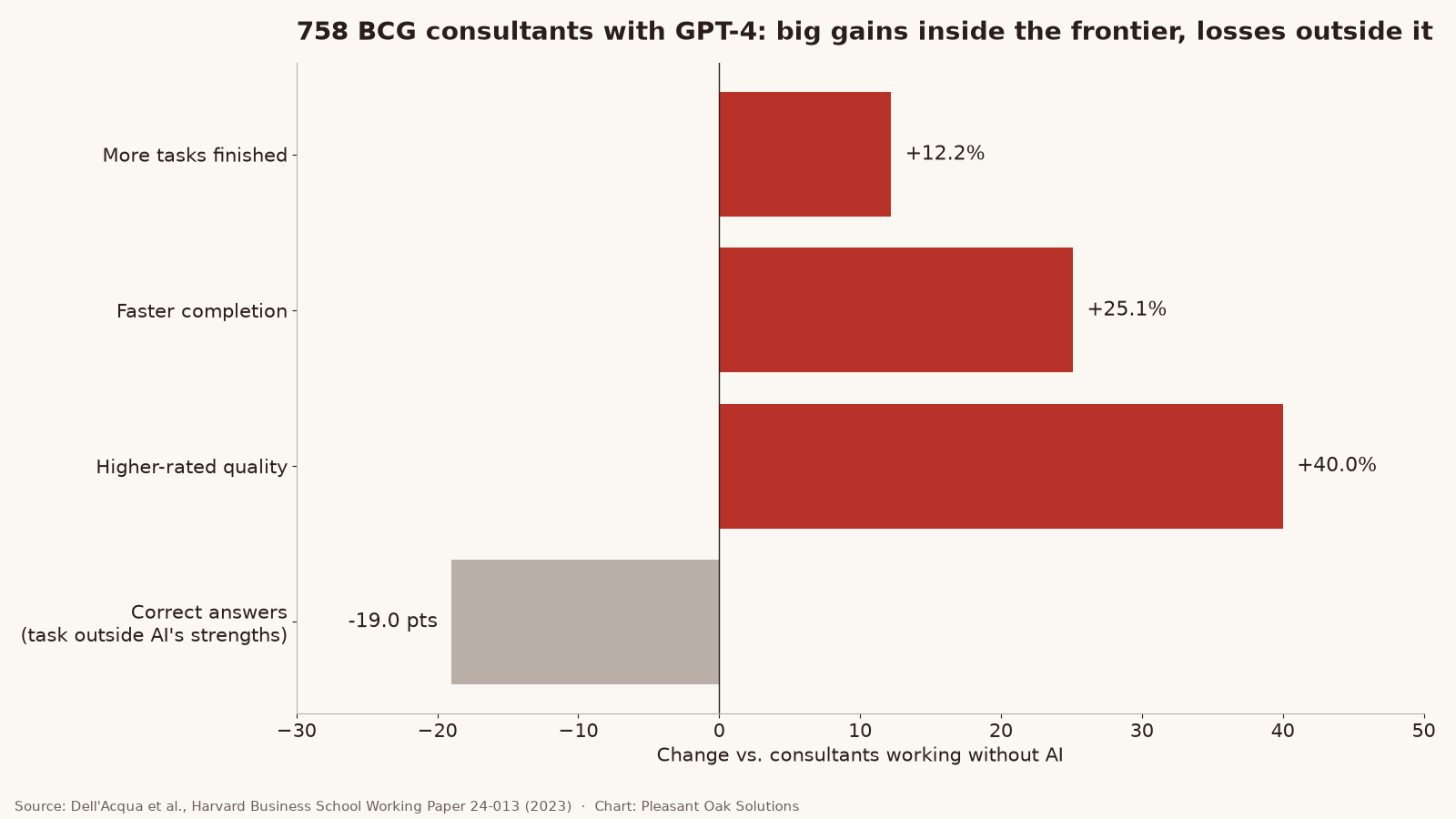
The best known is a 2023 Harvard Business School working paper by Fabrizio Dell'Acqua and colleagues, run with Boston Consulting Group. 758 consultants were given realistic tasks, some with GPT-4 and some without. On tasks inside what the authors called the "jagged technological frontier," the AI group finished 12.2 percent more tasks, worked 25.1 percent faster and produced work rated about 40 percent higher in quality.
Then came the twist. On a task deliberately chosen to sit just outside the AI's strengths, consultants using AI were 19 percentage points less likely to get the right answer than those working alone. The tool sounded just as confident when it was wrong.
A second study, by Erik Brynjolfsson, Danielle Li and Lindsey Raymond, tracked 5,179 customer support agents at a software company. An AI assistant raised issues resolved per hour by 14 percent on average. For the newest, least experienced agents the gain was 34 percent. For the most skilled agents it was close to zero.
Put those two studies side by side and you get the first leadership lesson. AI does not lift everyone equally. It compresses skill gaps, it is excellent at some tasks and quietly bad at neighboring ones, and nobody can tell you in advance exactly where the edge sits for your business. You have to find it.
Generative versus agentic: why the distinction matters
Generative AI produces something when asked: a draft, a summary, an image, a block of code. A person stays in the loop for every step.
Agentic AI is given a goal and works toward it across several steps. It might read an incoming email, look up the customer's order, draft a reply, issue a refund under a set limit and log the result. The person moves from doing each step to setting the rules and checking the outcomes.
That shift sounds technical. It is really an organizational design question. Once software can carry a task from start to finish, you have to decide who owns the result, what the agent is allowed to spend or promise, and how a human finds out when something goes wrong.
A cautionary case: when the savings story gets ahead of the service
In February 2024 the Swedish payments company Klarna announced that its AI assistant had handled 2.3 million customer conversations in its first month, about two-thirds of all its service chats. The company said that was the work of roughly 700 full-time agents.
It was a striking number, and it got repeated everywhere. By 2025, though, Klarna's own leadership was saying publicly that it would put more humans back into customer service, acknowledging that a focus on cost had come at the expense of quality.
We don't read that as a failure of the technology. We read it as a leadership lesson: the assistant was measured on volume and cost, and the things customers actually cared about were measured later, or not at all.
The four decisions only leaders can make
From the research and from the small-business rollouts we work on, four decisions keep showing up. None of them can be delegated to the IT budget.
1. Which work gets redesigned, not just sped up. List the ten tasks your team repeats most. For each one, ask whether AI would make it faster, or whether the task could be designed away entirely. Speeding up a bad process gets you a faster bad process.
2. Where the frontier sits for you. Run small, honest tests. Give the same task to people with and without the tool and compare the results blind. The BCG study shows why this matters: confidence is not accuracy.
3. What agents may decide on their own. Write it down the way you would for a new hire. "May issue refunds up to $50. May not change prices. Must escalate any complaint that mentions a lawyer."
4. How you will measure the outcome customers feel. Response time is easy to count. Whether the customer's problem was solved is harder, and it's the one that matters.
What changes in the org chart
The support study hints at something leaders should prepare for. When AI lifts junior performance most, the gap between a two-month employee and a two-year employee narrows. Training time shrinks. The value of senior people shifts toward judgment, exceptions and relationships.
That raises practical questions. If new staff become productive in weeks instead of months, how do you build the next generation of experts? If agents handle routine cases, how do your people get the reps they need to handle the hard ones? Firms that answer those questions on purpose will keep their bench strength. Firms that don't may find, in five years, that nobody left really understands the work.
A 30-day leadership sprint
This is how we would start, whether you run a ten-person firm or a department inside a larger one.
- Week 1: Map. List the 20 most repeated tasks. Mark each as "redesign," "assist" or "leave alone."
- Week 2: Test. Pick two "assist" tasks. Run them side by side, with and without AI, and have someone score the results without knowing which is which.
- Week 3: Write the rules. For any task where an AI might act on its own, write a one-page permission sheet: what it may do, what it may not, when it must hand off to a person.
- Week 4: Decide. Keep what clearly worked, drop what didn't, and pick the single workflow you'll redesign end to end next quarter.
Check your understanding
- In the BCG study, why did consultants using AI do worse on one task?
- Which workers gained the most in the customer support study, and what does that imply for training?
- What is one decision about an AI agent that should be written down before it goes live?
The bottom line
The electric motor did not transform factories. Managers who rebuilt factories around it did. The same will be true here. The leaders who get the most from generative and agentic AI won't be the ones who bought the most licenses. They'll be the ones who redesigned the work, tested where the tools fall short and stayed honest about what customers feel.
Sources
- Solow, R. "We'd Better Watch Out." New York Times Book Review, July 12, 1987.
- David, P. A. "The Dynamo and the Computer." American Economic Review, 1990.
- Dell'Acqua, F. et al. "Navigating the Jagged Technological Frontier." Harvard Business School Working Paper 24-013, 2023.
- Brynjolfsson, E., Li, D., Raymond, L. "Generative AI at Work." NBER Working Paper 31161, 2023.
- Klarna press release, February 27, 2024, and subsequent public statements by company leadership, 2025.
Take it with you
Get this guide as a PDF
A print-ready copy of this article — cover page, article body, and our contact block — yours in one click.
Want the same for your business?
Free 15-minute intake. We'll map the AI tools and automations that fit your practice.
Get my free plan →